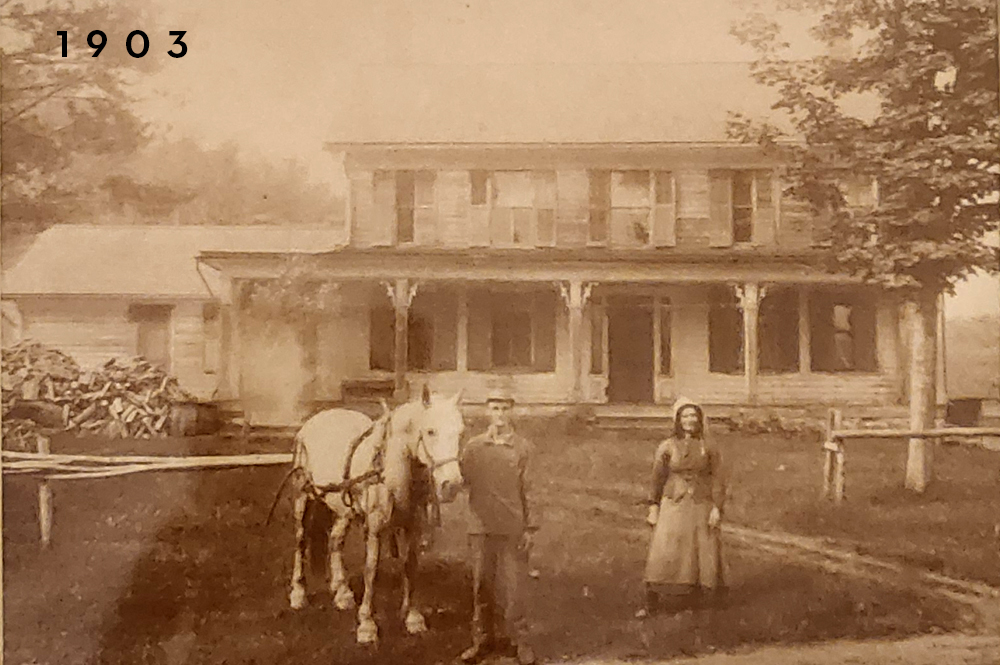
Image: Mary Müssig and Frank Winegar
Musicwoods Farm Name
One of the questions I get asked is, where did the name come from? While organizing the farm's documented history, I found many photos, maps, and documents. Among them was a document my father wrote, which I have updated with additional background.
Deed History Highlights
- December 2, 1768
- Jabez Hall purchased land in Lanesborough, Berkshire Co., Massachusetts, and moved there with his family.
- June 1, 1770
- He purchased more land, which was later left to his sons Lyman, Ezra, Gershom, Calvin, John and others after his death on May 6, 1776 .
- 1793
- Ezra Hall sold the farm for 100 pounds to Jonathan Lincoln who was married to his sister. . Over the next 20 years, Jonathan Lincoln acquired other local properties but did not own most of the Hall farm until later.
- Lyman Hall Sr. who had also fought in Canada with his 16 year old son, Lyman Jr. as his orderly. Farmed and established a tavern, frequented by English troops. With the Revolution, Lyman Jr. recruited a contingent at the Tavern and rose to be a Colonel in the American militia. He is buried in the Lanesborough old cemetery.
- 1833
- Lyman Hall sold some land and the "Hall Tavern" to the Massachusetts Life Insurance Company, a Boston financial firm. Other parts were sold to Jonathan Lincoln, grandson-in-law of Jabez Hall and his daughter Lydia.
Jonathan Lincoln was the great grand uncle of Abraham Lincoln. - 1838
- Jonathan Lincoln conveyed parts of the land to his children: Luther, Milton, Levi, Lydia, Lewis, and Alason Lincoln.
- 1850s
- Luther Lincoln sold the farm and some acres to Lorenzo Müssig.
The 1860 U.S. and Massachusetts censuses reveal that Lorenzo Müssig and his wife, Margaret, settled in Lanesborough, MA. - June 2, 1872
- Lorenzo Müssig purchased what we call the "high field" from Joseph Kesler.
- Late 1800s
- Lorenzo Müssig's daughter Mary married but was later widowed or abandoned. She lived with a handyman named Winegar, and they had a son, Frank.
- 1961
- Frank inherited the house upon Mary’s death. The property was held in trust until his passing in 1961.
- 1966
- My father bought the house and property, which had been split into two parts.
- 1969
- He bought the neighboring farm, inadvertently restoring the original Hall farm boundaries and sold the Farm and farm house to Corey family who have been our good friends for more than 55 years.
Historical Stories
Much of the early history was unknown to my family when they purchased the house and land. Frank, essentially a hermit, lived without electricity or indoor plumbing. The name "Müssig" in German means "softly" or "quietly." Lorenzo Müssig was listed as a farmer, born either in Switzerland (according to the U.S. Census) or Bavaria (according to Massachusetts records). The original deed for their purchase of the farm lists the seller as a Lincoln who was moving westward.
Margaret Müssig’s headstone now rests against a stone wall adjacent to our paddock, a quiet reminder of the past. By 1865, the Massachusetts Census listed a daughter, Mary, then four years old and "at home," as well as an older brother, about whom nothing is known. By this time, the family name had changed to Musig.
While exploring the house, my father discovered a strongbox hidden under an attic floorboard. It contained deeds, receipts for horses and equipment, tax records, and other documents—but no records of Mary’s marriage. Local old-timers recall stories of Mary and her son, Frank Winegar. Some claim that the Lincoln who sold the farm was related to President Abraham Lincoln. I found a family tree confirming this—he was indeed a great-grand-uncle of the president. Others say Frank’s father was either an itinerant worker or a farmhand named Winegar who disappeared under suspicious circumstances.
The strongbox also contained a magic holy stone, a rosary, an envelope marked “Twelve Prayers,” and a bottle labeled with a skull and crossbones—a collection that hints at the family’s beliefs and perhaps even local folklore.
A sepia photograph, taken in 1903 by the Howe Brothers of Ashfield, MA, shows Mary Musig and her son Frank Winegar standing in front of the house with a sturdy white horse in a D-ring harness. This photograph can be seen on our website. Mary and Frank made a living by selling firewood and fence posts in Pittsfield. A few older Lanesborough residents still remember them making deliveries and picking up provisions. I have also found an earlier photo of Frank as a child with his mother.
After Mary’s passing, Frank became a recluse. He survived mainly on berries, which he preserved in a giant earthen vat, and second-day bread, which he dried on the copper roof of the porch to make hardtack. He continued to cut firewood for his stove until his death in 1961. When we purchased the house in 1968, the attached wood shed and three barns were still filled to the rafters with stove wood.
This legacy is how we came to own "Musig’s woods." Our love for music also played a role in the name choice—my mother was a music teacher at Berkshire Country Day School and had a degree in music from the Hartt School. My father’s mother was a concert pianist. My brothers, Tom and Peter, are both in the music and film industries. In 1977, I won the Berkshire Symphony Music Award when I graduated from Mt. Greylock Regional High School. Naming the property "Musicwoods Farm" was a natural choice.
This rich history, from the Jabez Hall family to today, is woven into the very fabric of Musicwoods Farm. It’s not just a piece of land but a place filled with stories, memories, and traditions that continue to inspire us. My goal is to preserve its history, legacy, and the conservation of the land.
.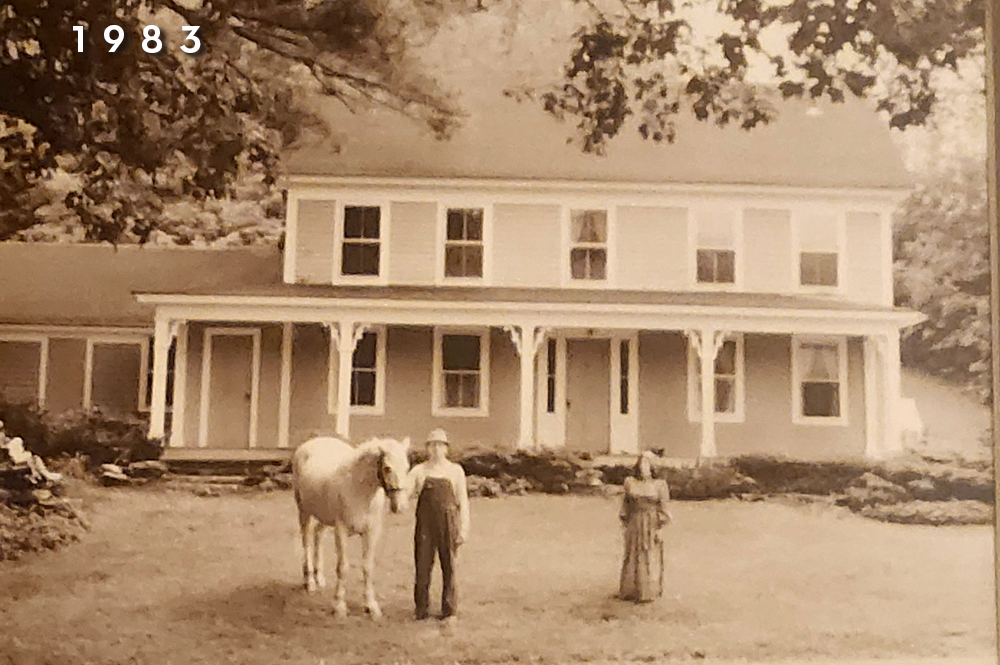
Image: Dr. Alexander and Aline Drescher - Duck Soup
Leave a Comments

© 2023 wmdrescher